AI Tools
Claude vs ChatGPT for Business: Which AI Should You Actually Use?
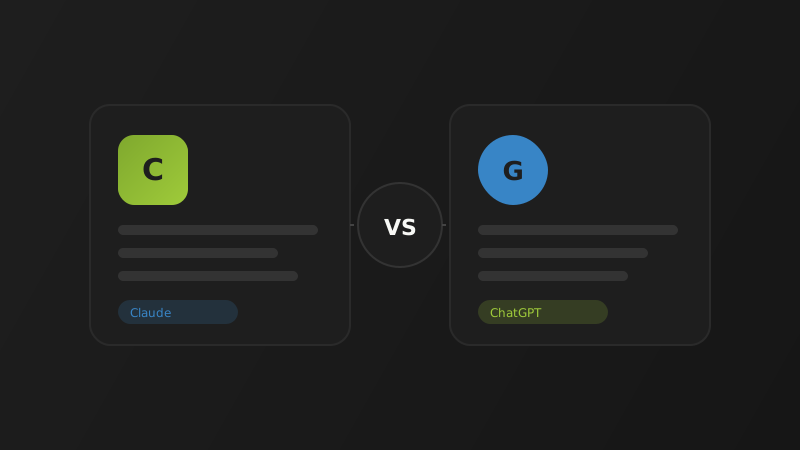
If you've tried to research "Claude vs ChatGPT" for your business, you've probably hit the same wall we did: dozens of articles, each picking a winner, most of them written by someone with an affiliate link to sell. The honest answer is less dramatic than any of those headlines. Both tools are genuinely capable. Neither one wins every category. The useful question isn't "which AI is smarter" — it's which one fits the specific work your team actually does.
Claude's biggest practical advantage for business use is instruction-following on long, detailed tasks. If you hand it a style guide, a contract, or a multi-step brief and ask it to stick to every constraint across a long document, it tends to hold the thread better than most alternatives. That matters more than it sounds — a model that drifts off your brand voice by paragraph ten of thirty means more editing, not less time.
Claude also tends to produce writing that reads as more natural and less formulaic, which is why a lot of teams default to it for client-facing documents, proposals, and reports. And for anything document-heavy — contracts, compliance reviews, long policy manuals — Claude's larger context window means it can often work with the entire document in one pass instead of chunking it into pieces and losing coherence between them.
ChatGPT's advantage is breadth. It generates images natively, handles voice interaction, browses the web, and plugs into a much larger ecosystem of third-party integrations and custom tools. If your work involves visual content, quick multimodal tasks, or you want one tool that does a wide variety of things reasonably well without extra setup, ChatGPT's ecosystem is hard to match.
For fast, high-volume, lower-stakes content — internal notes, quick drafts, brainstorming — ChatGPT is often faster to get a usable first pass out of, since raw polish matters less for that kind of work.
In our own work, the deciding factor is rarely "which model is objectively better." It's which one matches the task in front of you:
Pricing at the standard tier has converged — both charge roughly the same for a solid individual plan — so cost alone rarely settles the decision anymore. What settles it is workflow fit.
A growing number of teams don't pick one. They use Claude for document-heavy, careful work and ChatGPT for broader day-to-day tasks and anything visual — treating them as two tools with different strengths rather than competing subscriptions. If you're building AI into an actual business process (support triage, document review, internal search), the model choice should follow the task, not the other way around.
If you're trying to figure out where AI actually fits into your operations — not just which chatbot to open — that's the conversation we have with clients before writing a line of code. We scope the workflow first, then match the tool to it.