AI Tools
What Are AI Agents? A Plain-English Guide for Business Owners
"AI agent" has become one of those terms that gets used so broadly it's stopped meaning anything specific. Software vendors slap it on everything from a simple chatbot to a fully autonomous system. Here's what actually separates an agent from a regular AI chat tool, and where the distinction matters for a business.
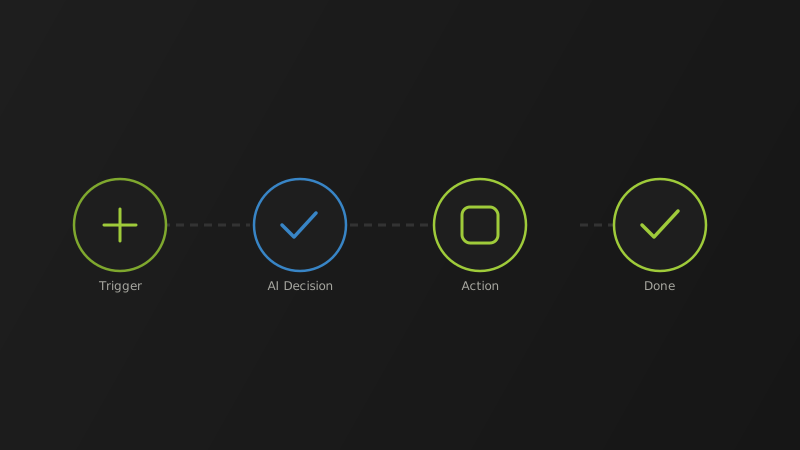
A standard AI chatbot answers a question and stops. You ask, it responds, the interaction ends. An AI agent is built to do something with that response — look something up, take an action in another system, check whether the result was correct, and decide the next step on its own, often across several steps in a row without a human approving each one.
A simple example: asking a chatbot "what's the status of order #4521" gets you an answer if you already know where to look. An agent handling the same request might check the order system, see it's delayed, check the shipping carrier's tracking API, draft an explanation, and send it to the customer — several actions chained together, with no one manually doing each step.
The current generation of AI agents can reliably hold a long chain of instructions together — research something, summarize it, and format the output a specific way — and can interact directly with real software: reading a spreadsheet, browsing a website, using an application the way a person would. That's a meaningful jump from a model that can only produce text.
Giving an agent more autonomy means giving it more room to make a wrong call at scale before anyone notices. Mature deployments keep a human in the loop for anything higher-stakes — sending money, making a customer-facing commitment, deleting data — and treat full autonomy as something to earn after the workflow has been tested, not the starting point. Most well-run agent deployments are judged by their "automation ratio": how much of the workflow runs unsupervised, with the risky remainder still routed to a person.
An AI agent isn't a smarter chatbot — it's software that can take multi-step action on your behalf inside real systems, with a defined boundary for when a human needs to step in. That makes it genuinely useful for well-defined, repeatable business workflows, and genuinely risky if deployed without guardrails on anything that matters. The businesses getting real value from agents in 2026 are the ones that scoped a narrow, well-understood workflow first — not the ones that tried to hand over "the whole department" on day one.
Building an AI agent into a real business workflow is a scoping problem before it's an engineering problem — deciding exactly what it should and shouldn't be allowed to do on its own. That's where we start every AI & Automation engagement.